Not long ago, creating content for your business felt relatively straightforward. You updated your website so customers could find you. You posted on social media to stay in touch with people. Perhaps you wrote the occasional article because you had something useful to say or wanted to share your expertise.
Somewhere along the way, though, things seem to have changed.
Today, being a business owner often feels like being expected to wear half a dozen additional hats. We're encouraged to become marketers, writers, photographers, videographers, and now increasingly, experts in SEO and AI search. The advice arrives from every direction: create more content, answer more questions, publish more often, optimise for search engines, think about AI discovery.
Individually, none of this advice is bad. Customers search online, and businesses need to be discoverable. But taken together, it sometimes feels like we've found ourselves on a treadmill that never quite stops.
And perhaps that's why I keep coming back to a question that I suspect many business owners quietly ask themselves:
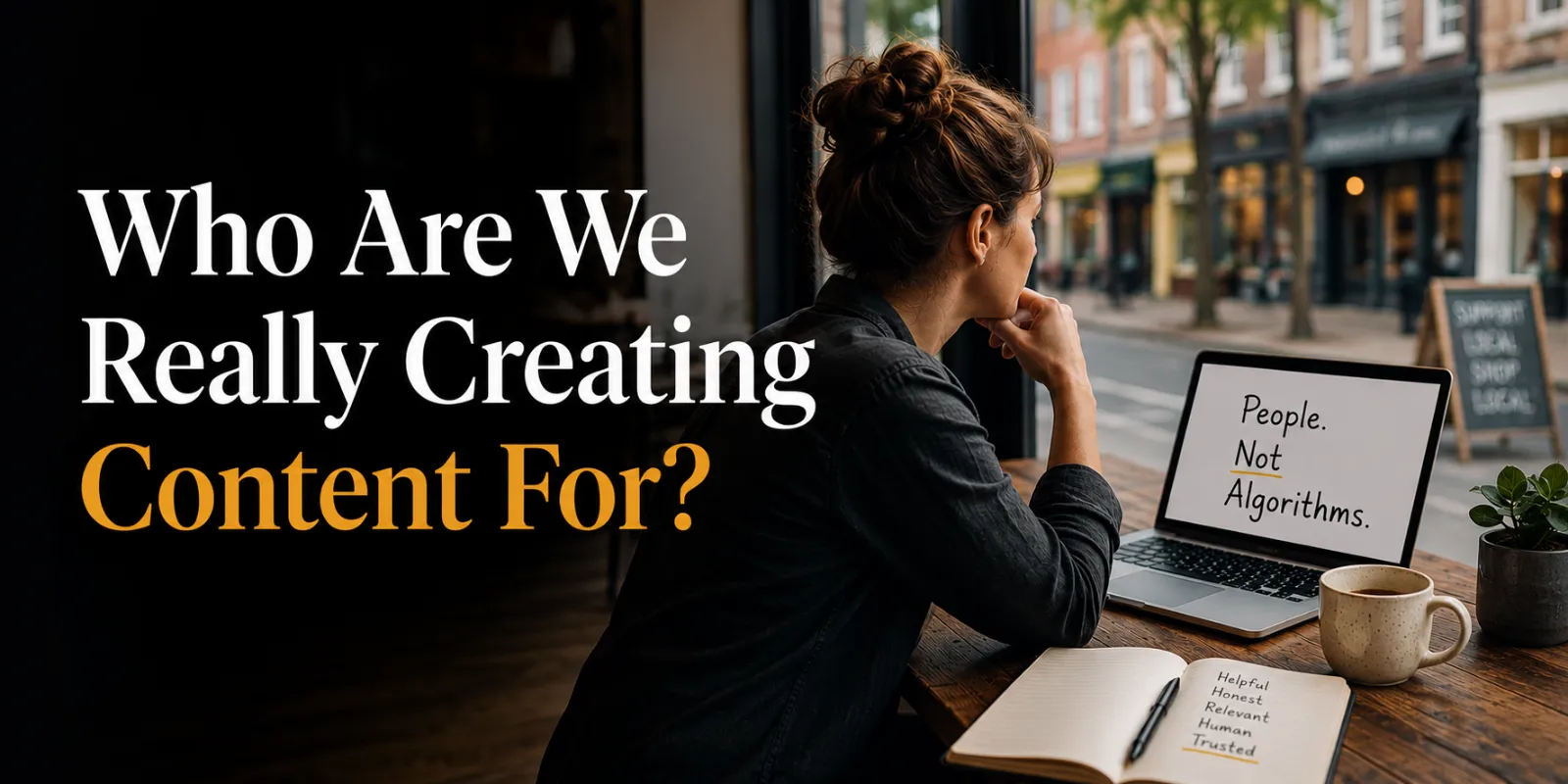
Who exactly are we creating all this content for?
Because if we're honest, there are days when it feels less like we're writing for customers and more like we're writing for machines. We carefully structure our headings for search engines. We choose keywords that algorithms might favour. We answer questions because AI systems may surface them. Increasingly, our content isn't simply being read by people, it's being processed, indexed, summarised, and learned from by technology platforms.
That's not necessarily a criticism. It's simply an observation.
After all, search engines have transformed how businesses are discovered, and AI is rapidly changing how people find information. I use these tools myself and can see the opportunities they create. Yet there is a strange irony at the heart of modern marketing. Millions of small businesses invest countless hours creating content that not only serves customers but also powers some of the largest technology companies in the world.
Every blog post adds to the web.
Every answer helps train systems.
Every piece of expertise becomes part of a much larger machine.
Which raises an uncomfortable question: who is benefiting most from all this effort?
The Hidden Cost of Content Creation
One aspect of the content conversation that often gets overlooked is time.
Creating genuinely useful content isn't quick. A thoughtful article isn't simply written in twenty minutes over a cup of coffee. It requires research, reflection, editing, structure, examples, images, and perhaps most importantly, the ability to understand what readers actually care about.
Good content is hard. Great content is even harder.
Yet much of the advice aimed at small businesses makes it sound deceptively simple. "Start a blog." "Post on social media." "Create videos." As though every founder naturally has the time, skills, or energy to become a content creator alongside running a business.
The reality is often very different.
Most independent business owners didn't start their businesses because they wanted to become publishers. A plumber wanted to solve problems. A café owner wanted to create a welcoming space. A therapist wanted to help people. A local retailer wanted to share products they care about. Yet increasingly, many find themselves spending evenings writing articles, creating posts, or worrying that they're not producing enough content to remain visible.
And even when the time exists, another challenge remains: creating content that people genuinely want to read.
Not everyone feels comfortable writing. Not everyone enjoys marketing. Not everyone can afford to hire a copywriter, marketing agency, or content specialist. For many small businesses, professional content creation sits firmly in the category of "something we'd love to do if we had the budget."
Perhaps that's one reason why AI has been adopted so quickly.
AI offers something incredibly attractive to busy founders: speed. It helps turn ideas into drafts, creates social posts in minutes, and lowers the barrier to creating content. In many ways, it's democratising skills that were previously out of reach for smaller businesses.
But there is a trade-off.
If everyone uses the same tools, the same prompts, and increasingly similar approaches, do we risk creating a digital world where businesses begin to sound alike?
It's a question I explored in a previous article about whether AI is causing businesses to look increasingly similar. The more I think about it, the more I believe the challenge isn't AI itself. The challenge is ensuring that technology amplifies our voice rather than replacing it.
After all, customers don't buy from perfectly optimised content.
They buy from businesses they trust.
And trust is still one of the few things that can't be generated at the press of a button.

Search Engines Help People Find You. Trust Helps Them Choose You.
Visibility matters. Without it, even the best businesses can remain hidden. But visibility alone has never been enough.
Customers rarely choose a business because it ranked first in search results. They choose businesses because they trust them. Because they feel understood. Because they believe that person or company can solve their problem.
Credibility isn't built by keywords alone.
Trust isn't created by ticking SEO boxes.
It grows through consistency, expertise, relationships, recommendations, and familiarity.
Sometimes it comes from seeing a business repeatedly in their local patch. Sometimes it's hearing their name mentioned by someone they trust. Sometimes it's simply the feeling that you've come across them enough times to believe they must know what they're doing.
That feeling of familiarity is powerful.
Search engines may help people find you.
Trust helps them choose you.

Finding the Balance in an AI World
This isn't an argument against AI, nor is it a call to ignore search engines. Businesses still need to be discoverable, and technology can be a powerful tool for helping independent businesses compete.
Perhaps the challenge is not whether we should use AI, but how we use it.
If AI helps us spend less time staring at blank pages and more time serving customers, that's surely a good thing. But if we become so focused on pleasing algorithms that we forget who we're actually trying to help, we risk losing something important.
Because customers can often tell the difference.
Content written purely to rank tends to feel hollow.
Content written from experience tends to feel human.
And in a world increasingly filled with AI-generated words and images, being human may quietly become one of the strongest advantages a business can have.
The businesses that thrive may not be those creating the most content.
They may simply be the ones creating the most value.
So perhaps the next time we sit down to write a blog, create a social post, or record a video, it may be worth asking a simple question:
Am I creating this for an algorithm, or for the person I genuinely hope to help?
Because if we win over customers, perhaps the algorithms will eventually follow. But if we spend all our time chasing algorithms, we risk forgetting who we were trying to reach in the first place.
What do you think? Have we become creators for customers, or creators for machines?