QR Codes Are Everywhere. So Why Do Phone Numbers Still Work?
Walk through any high street, café, or community noticeboard today and you'll notice something almost impossible to miss: QR codes.
They're on posters, menus, shop windows, event flyers, and business cards. Scan here. Book here. Learn more here.
A few years ago, QR codes felt novel. Today, they've become almost expected.
Yet recently I've noticed something interesting. Despite how common QR codes have become, many independent businesses still receive their best enquiries through something far simpler: a phone call.
Perhaps that's because local business has never been purely about technology. It's about people.
And while digital tools help people discover you, human contact often helps them choose you.
Convenience Doesn't Always Equal Connection
QR codes are undeniably useful.
They can send people to websites, booking forms, menus, social media pages, or business profiles in seconds. For businesses, they offer flexibility and measurable engagement.
But convenience isn't always the same as connection.
When someone scans a QR code, they're entering another digital space filled with distractions. Notifications appear. Messages arrive. Tabs multiply. Attention drifts.
A phone call is different.
Calling someone requires intent. It creates a moment of direct interaction. Even a short conversation can answer questions, build confidence, and reassure a customer they're dealing with a real person.
For independent businesses, that human connection is often one of the greatest advantages they have.
Local Businesses Are Built on Familiarity
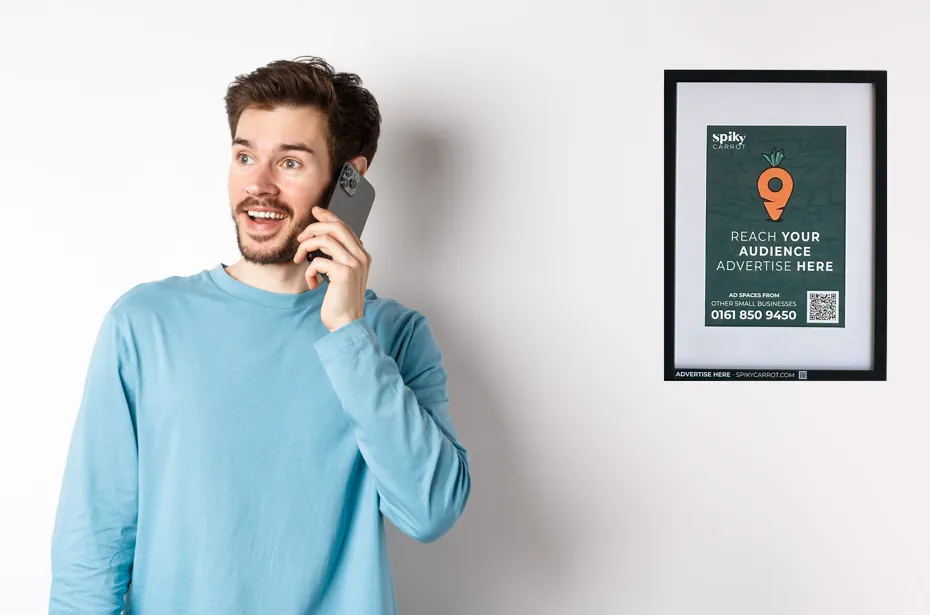
There's something reassuring about seeing a phone number on a poster.
It quietly signals that there is a real person behind the business. Someone who can answer a question, solve a problem, or simply have a conversation.
This matters particularly in local communities.
People often choose independent businesses because they value familiarity, trust, and personal service. A visible phone number reinforces those qualities in a way a QR code alone sometimes cannot.
It isn't necessarily about technology being better or worse. It's about recognising that people engage differently.
Some prefer to scan.
Others prefer to call.
The strongest local marketing gives people both options.
Accessibility Is Easy to Overlook
Businesses often design marketing for the customers they imagine rather than the customers they actually have.
Not everyone feels comfortable scanning QR codes. Some people have older devices. Others may struggle with accessibility. Mobile signal isn't always reliable either.
A printed phone number remains remarkably resilient.
It can be read, remembered, written down, or called later.
Good local marketing doesn't create barriers. It reduces them.
The easier you make it for someone to contact you, the more likely they are to do so.
Recognition Often Matters More Than Reach
Much of modern marketing focuses on clicks, impressions, and traffic.
Yet local business often works differently.
Recognition matters.
People rarely act the first time they see a business. They notice a poster in a café. They see the same name on social media. They hear someone mention the business locally. Eventually, they need that service and remember the name.
A memorable phone number can play a role in that recognition.
Even if someone doesn't call immediately, the number itself becomes another touchpoint that reinforces familiarity.
Being remembered is often more valuable than simply being seen.
The Best Approach Isn't QR Codes or Phone Numbers
It's both.
QR codes are excellent for directing people towards websites, bookings, and business profiles.
Phone numbers offer direct human connection.
Together, they allow customers to engage in the way that feels most comfortable to them.
Independent businesses thrive when they make it easy for people to take the next step, however they prefer to do it.
As businesses increasingly adopt digital tools, perhaps the businesses that stand out won't be those using the newest technology, but those remembering that local growth still happens through trust, conversation, and relationships.
After all, in a world filled with QR codes, perhaps hearing a real voice has become surprisingly memorable.
And as local businesses think about visibility in the years ahead, the question may not be whether people can find you.
It's whether they feel comfortable contacting you when they do.